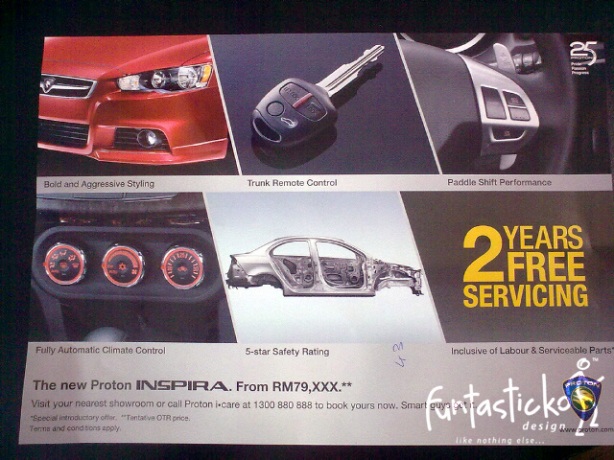
Sah aku blom mampu lagi...
Sumber : Blog automotif tempatan
Showing posts with label automotive. Show all posts
Wednesday, October 20, 2010
Saturday, October 16, 2010
Proton Emas view pd public
Sempena pertandingan kemahiran malaysia (PKM) sekarang ni tengah berlangsung kat CIAST, proton menampilkan kederaan eco friendly kat public, dulu aku ada pernah terbaca jugak tentang proton nak produce eco-friendly car ni, tak tak brapa follow sgt, tgk pada design, mmg comel jugak, kalu harga murah, bole la ambik satu wat g kedai beli cekedis.. Kalu harga macam Inspirrahhh.. terpaksa la let go dulu.. hehe
Gambar proton Emas
Design dari Itali
Gambar pow dariArt...
TQ
Gambar proton Emas
Design dari Itali
Gambar pow dariArt...
TQ
Friday, October 15, 2010
Proton Inspira - Perbandingan Harga
PROTON INSPIRA
1.8 (M) - From RM79,888
1.8 (CVT) - to
2.0(CVT) - RM 95,000
MITSUBIHSI
Mitsubishi Lancer 2.0GT – RM123,980
TOYOTA
Toyota Vios 1.5 TRD Sportivo – RM92,990
Toyota Vios 1.5G – RM87,990
Toyota Vios 1.5E – RM81,990
Toyota Vios 1.5J (A) -RM76,990
Toyota Vios 1.5J (M) – RM71,990
HONDA
Honda City 1.5L Grade S – RM84,980
Honda City 1.5L Grade E – RM89,980
Honda Civic 1.8 Sedan – RM114,980
Honda Civic 2.0 Sedan – RM129,980
Honda Jazz 1.5L Grade S – RM104,800
Honda Jazz 1.5L Grade V – RM109,800
NISSAN
Nissan Latio 1.8Ti (AT) – RM99,958
Nissan Latio 1.6ST (MT) – RM84,680
Nissan Latio 1.6ST (AT) – RM88,980
Nissan Latio 1.6ST-L (AT) – RM92,930
Nissan Latio Sport 1.6ST-L (AT) – RM96,880
Nissan Sentra SPort 1.6L (M) – RM85,750
Nissan Sentra SPort 1.6L (A) – RM89,800
Nissan Sylphy 2.0L Comfort (A) – RM114,850
Nissan Sylphy 2.0L Luxury (A) – RM116,800
NAZA
Naza Forte 1.6EX – RM75,800
Naza Forte 1.6SX – RM81,800
Naza Forte 2.0SX – RM93,800
MAZDA
Mazda 3 Sport 1.6 – RM103,017
Mazda 3 Sport 2.0 – RM133,537
Credit : http://harga-kereta.blogspot.com
& Thestar & funtustico design
1.8 (M) - From RM79,888
1.8 (CVT) - to
2.0(CVT) - RM 95,000
MITSUBIHSI
Mitsubishi Lancer 2.0GT – RM123,980
TOYOTA
Toyota Vios 1.5 TRD Sportivo – RM92,990
Toyota Vios 1.5G – RM87,990
Toyota Vios 1.5E – RM81,990
Toyota Vios 1.5J (A) -RM76,990
Toyota Vios 1.5J (M) – RM71,990
HONDA
Honda City 1.5L Grade S – RM84,980
Honda City 1.5L Grade E – RM89,980
Honda Civic 1.8 Sedan – RM114,980
Honda Civic 2.0 Sedan – RM129,980
Honda Jazz 1.5L Grade S – RM104,800
Honda Jazz 1.5L Grade V – RM109,800
NISSAN
Nissan Latio 1.8Ti (AT) – RM99,958
Nissan Latio 1.6ST (MT) – RM84,680
Nissan Latio 1.6ST (AT) – RM88,980
Nissan Latio 1.6ST-L (AT) – RM92,930
Nissan Latio Sport 1.6ST-L (AT) – RM96,880
Nissan Sentra SPort 1.6L (M) – RM85,750
Nissan Sentra SPort 1.6L (A) – RM89,800
Nissan Sylphy 2.0L Comfort (A) – RM114,850
Nissan Sylphy 2.0L Luxury (A) – RM116,800
NAZA
Naza Forte 1.6EX – RM75,800
Naza Forte 1.6SX – RM81,800
Naza Forte 2.0SX – RM93,800
MAZDA
Mazda 3 Sport 1.6 – RM103,017
Mazda 3 Sport 2.0 – RM133,537
Credit : http://harga-kereta.blogspot.com
& Thestar & funtustico design
Thursday, October 14, 2010
Proton Inspira
Dah start bole booking hr ni...
Didatangkan dengan 3 variasi
1.8L Manual
1.8L CVT
2.0LCVT
Gambar dicedok dari blog2 automotif tempatan.
Didatangkan dengan 3 variasi
1.8L Manual
1.8L CVT
2.0LCVT
Gambar dicedok dari blog2 automotif tempatan.
Wednesday, December 02, 2009
How to Maximise Your Fuel
Before you drive
1. Tune and service your engine – A well-tuned engine can improve fuel economy by up to 5%*, so always use the recommended grade of motor oil like Shell Helix and follow your car manufacturer’s recommendations on servicing.
2. Keep your tyres at the right pressure – Correctly inflated tyres are safer, last longer and drive more efficiently. A tyre that is under-inflated by just 1psi can reduce fuel efficiency by 1-2%.* An under- or over-inflated tyre is also more susceptible to failing and blowout.
3. Avoid carrying excess weight – For every extra 100lbs (45kg) you carry your fuel efficiency can drop by 1-2%*, so keep your boot or back seat clear of unnecessary items that just add weight to your vehicle.
4. Take the roof rack off – If you’re not using your roof rack then remove it. Racks affect the aerodynamic efficiency of your car, creating drag which can result in your car using up to 5% more fuel*. It all adds up to less mileage.
5. Plan trips carefully - Cutting down on the time spent in the car is the easiest way to conserve fuel. To reduce driving time, know where you’re going and, if possible, travel outside of peak times.
While driving
1. Drive smoothly and keep calm – Aggressive driving can use as much as a third more fuel than safe driving. Avoid accelerating or braking too hard and try to keep your steering as smooth as possible.
2. Use high gears and avoid over-revving – The higher gear you drive in, the lower your engine speed is, which can improve fuel efficiency. Change up a gear whenever you can, without labouring the engine. Never ‘redline’ the rev counter because you unnecessarily waste fuel.
3. Use cruise control and avoid high speeds – Using cruise control on major roads helps you maintain a constant speed and, in many cases, will reduce fuel consumption.As well as potentially dangerous, fast driving can waste fuel. Approximately at 70mph (110kmph) you could be using up to 30 per cent more fuel than at 50mph (80 kmph)**. So remember: the faster you drive, the more fuel you’ll consume.
4. Avoid excess idling – Idling gets you nowhere but still burns fuel. Turn the engine off when you’re in a queue or waiting for someone for more than a minute or two. Use ‘Start-Stop’ button/functionality, when available in your car.
5. Use air conditioning sparingly – Air conditioning puts added strain on the engine. Try to limit its use to particularly hot days only. Alternatively you can wind down the window - though you will lose some fuel efficiency with the window open, it is still far more economical than using the air conditioner.
source : http://www.shell.com/
1. Tune and service your engine – A well-tuned engine can improve fuel economy by up to 5%*, so always use the recommended grade of motor oil like Shell Helix and follow your car manufacturer’s recommendations on servicing.
2. Keep your tyres at the right pressure – Correctly inflated tyres are safer, last longer and drive more efficiently. A tyre that is under-inflated by just 1psi can reduce fuel efficiency by 1-2%.* An under- or over-inflated tyre is also more susceptible to failing and blowout.
3. Avoid carrying excess weight – For every extra 100lbs (45kg) you carry your fuel efficiency can drop by 1-2%*, so keep your boot or back seat clear of unnecessary items that just add weight to your vehicle.
4. Take the roof rack off – If you’re not using your roof rack then remove it. Racks affect the aerodynamic efficiency of your car, creating drag which can result in your car using up to 5% more fuel*. It all adds up to less mileage.
5. Plan trips carefully - Cutting down on the time spent in the car is the easiest way to conserve fuel. To reduce driving time, know where you’re going and, if possible, travel outside of peak times.
While driving
1. Drive smoothly and keep calm – Aggressive driving can use as much as a third more fuel than safe driving. Avoid accelerating or braking too hard and try to keep your steering as smooth as possible.
2. Use high gears and avoid over-revving – The higher gear you drive in, the lower your engine speed is, which can improve fuel efficiency. Change up a gear whenever you can, without labouring the engine. Never ‘redline’ the rev counter because you unnecessarily waste fuel.
3. Use cruise control and avoid high speeds – Using cruise control on major roads helps you maintain a constant speed and, in many cases, will reduce fuel consumption.As well as potentially dangerous, fast driving can waste fuel. Approximately at 70mph (110kmph) you could be using up to 30 per cent more fuel than at 50mph (80 kmph)**. So remember: the faster you drive, the more fuel you’ll consume.
4. Avoid excess idling – Idling gets you nowhere but still burns fuel. Turn the engine off when you’re in a queue or waiting for someone for more than a minute or two. Use ‘Start-Stop’ button/functionality, when available in your car.
5. Use air conditioning sparingly – Air conditioning puts added strain on the engine. Try to limit its use to particularly hot days only. Alternatively you can wind down the window - though you will lose some fuel efficiency with the window open, it is still far more economical than using the air conditioner.
source : http://www.shell.com/
Friday, November 20, 2009
Thermostat Enjin
Ujung minggu ni free sket, sebab kawan wife tak jadi nak datang rumah, so berkira-kira nak (Do – It – Yourself) DIY la servis keta kat rumah, bole lah save cost sket time-time gawat camnih. Lagipun rasanya tak susah setakat nak tukar minyak enjin dengan tukar air radiator. Dah belek2 kat forum-forum automotif td, tak berapa rumit sangat la nak realisasikan projek DIY nih.
Satu lagi, keta ni nak kena pasang thermostat balik lah, sbb rujuk kat forum teknikal n wikipedia. Enjin sesebuah kereta tu beroperasi pada suhu tertentu untuk mendapatkan prestasi yang optimum. Last year, pomen panel sy dah remove benda ni sbb katanya kita ni duduk kat Malaysia, cuaca panas n lembab, so tak perlu la pakai thermostat sebab thermostat ni direka untuk kereta kat jepun yang mana suhu kat negara diorang kadang tu 5 darjah Celcius saja.
So hampir setahun jugak la running enjin tanpa thermostat, so far ok lah tapi masalah nya enjin lambat sangat nak capai suhu pengoperasian. Kalau setakat 5-6 minit panaskan enjin, tak sampai setakuk pon pada meter suhu tu. So memang lambat la. Biasanya kena jalan dulu baru dapat suhu yang dikehendaki. Kekadang tu kalu drive malam or dalam hujan, suhu pon drop jugak sampai suku jer. Suhu yang sepatutnya ialah kat tengah-tengah kurang sikit-skit jer. Ni sy refer kat forum automotif la..
Based on article kat HowStuffWork n Wikipedia, thermostat mempunyai beberapa fungsi yang penting dalam sistem penyejukan enjin. Salah satu nya nak mempercepatkan enjin mencapai suhu yang dikehendaki untuk beroperasi dengan cara menyekat air daripada mengalir kedalam radiator jika suhu enjin masih sejuk. Ini kerana thermostat biasanya akan membukat pintu aliran air ke radiator pada suhu 82-85 darjah celcius.
Selain daripada tu, themostat jugak memastikan suhu sentiasa berada dalam keadaan stabil dengan cara mengawal kadar bukaan pintu aliran air ke radiator. Jika suhu tidak terlalu panas. Maka aliran yang dibenarkan melalui termostat adalah perlahan sahaja kerana pintu aliran dibuka sedikit sahaja. Jika suhu enjin sudah tinggi, maka pintu aliran akan dibuka semaksimum mungkin untuk membolehkan air mengalir dengan lebih pantas seterusnya mengyejukkan enjin kereta anda.
Nway, maklumat kat atas tu mebbe ada sedikit kekurangan sebab sy ni bukan student automotif, tp cukup untuk sekadar menjaga enjin kereta kesayangan sendiri. Karang kalu dah kena overheat enjin, lagi banyak plak modal kena keluar untuk repair. Lagi pon dengan DIY ni dapat la berjimat cermat sket. Bak seruan pemimpin kita suruh rakyat Ubah Gaya Hidup. Pasni tak payah makan nasi, makan ubi kayu jer.. hehhe.. pastu kalu yang perut jenis makan nasi.. jangan risau, sumbat jer ubi kayu tu bebanyak.. baru kenyang..
Adios...
Satu lagi, keta ni nak kena pasang thermostat balik lah, sbb rujuk kat forum teknikal n wikipedia. Enjin sesebuah kereta tu beroperasi pada suhu tertentu untuk mendapatkan prestasi yang optimum. Last year, pomen panel sy dah remove benda ni sbb katanya kita ni duduk kat Malaysia, cuaca panas n lembab, so tak perlu la pakai thermostat sebab thermostat ni direka untuk kereta kat jepun yang mana suhu kat negara diorang kadang tu 5 darjah Celcius saja.
So hampir setahun jugak la running enjin tanpa thermostat, so far ok lah tapi masalah nya enjin lambat sangat nak capai suhu pengoperasian. Kalau setakat 5-6 minit panaskan enjin, tak sampai setakuk pon pada meter suhu tu. So memang lambat la. Biasanya kena jalan dulu baru dapat suhu yang dikehendaki. Kekadang tu kalu drive malam or dalam hujan, suhu pon drop jugak sampai suku jer. Suhu yang sepatutnya ialah kat tengah-tengah kurang sikit-skit jer. Ni sy refer kat forum automotif la..
Based on article kat HowStuffWork n Wikipedia, thermostat mempunyai beberapa fungsi yang penting dalam sistem penyejukan enjin. Salah satu nya nak mempercepatkan enjin mencapai suhu yang dikehendaki untuk beroperasi dengan cara menyekat air daripada mengalir kedalam radiator jika suhu enjin masih sejuk. Ini kerana thermostat biasanya akan membukat pintu aliran air ke radiator pada suhu 82-85 darjah celcius.
Selain daripada tu, themostat jugak memastikan suhu sentiasa berada dalam keadaan stabil dengan cara mengawal kadar bukaan pintu aliran air ke radiator. Jika suhu tidak terlalu panas. Maka aliran yang dibenarkan melalui termostat adalah perlahan sahaja kerana pintu aliran dibuka sedikit sahaja. Jika suhu enjin sudah tinggi, maka pintu aliran akan dibuka semaksimum mungkin untuk membolehkan air mengalir dengan lebih pantas seterusnya mengyejukkan enjin kereta anda.
Nway, maklumat kat atas tu mebbe ada sedikit kekurangan sebab sy ni bukan student automotif, tp cukup untuk sekadar menjaga enjin kereta kesayangan sendiri. Karang kalu dah kena overheat enjin, lagi banyak plak modal kena keluar untuk repair. Lagi pon dengan DIY ni dapat la berjimat cermat sket. Bak seruan pemimpin kita suruh rakyat Ubah Gaya Hidup. Pasni tak payah makan nasi, makan ubi kayu jer.. hehhe.. pastu kalu yang perut jenis makan nasi.. jangan risau, sumbat jer ubi kayu tu bebanyak.. baru kenyang..
Adios...
Monday, August 25, 2008
The beast has come

It is one of my favorite cars, now available in Malaysia. The price tag is 3xx,xxx.xx. hehee, quite impressive price. Read more @ link below.
http://www.zerotohundred.com/2008/auto-news/mitsubishi-evolution-x-officially-launched-in-malaysia/
http://paultan.org/archives/2008/08/24/new-mitsubishi-lancer-evolution-now-in-malaysia/
Thursday, July 03, 2008
Lancer Evolution Spec Brief
Lancer EVO1 spec
engine : 1997
Power : 250PS @ 6000rpm
Torque : 288lbs/ft @ 300rpm
Weight : 1240kg (RS 1170kg)
Top speed : 143mph
0-60mph : 5.1 second
Lancer EVO2 spec
engine : 1997
Power : 260PS @ 6000rpm
Torque : 288lbs/ft @ 300rpm
Weight : 1250kg (RS 1180kg)
Top speed : 147mph
0-60mph : 5.0 second
Lancer EVO3 spec
engine : 1997
Power : 270PS @ 6000rpm
Torque : 288lbs/ft @ 300rpm
Weight : 1260kg (RS 1170kg)
Top speed : 149mph
0-60mph : 4.9 second
engine : 1997
Power : 250PS @ 6000rpm
Torque : 288lbs/ft @ 300rpm
Weight : 1240kg (RS 1170kg)
Top speed : 143mph
0-60mph : 5.1 second
Lancer EVO2 spec
engine : 1997
Power : 260PS @ 6000rpm
Torque : 288lbs/ft @ 300rpm
Weight : 1250kg (RS 1180kg)
Top speed : 147mph
0-60mph : 5.0 second
Lancer EVO3 spec
engine : 1997
Power : 270PS @ 6000rpm
Torque : 288lbs/ft @ 300rpm
Weight : 1260kg (RS 1170kg)
Top speed : 149mph
0-60mph : 4.9 second
Monday, May 26, 2008
4G67 Spec brief
Grade MS, produced from 1989 (october)
Add to comparsion list
GENERAL
Body type Sedan
Drive FF
Transmission Advanced 5 speed manual
Displacement, cc 1836
Frame E-E35A-SNXM
Price of new car, thousands yen (Tokyo area) 1798 (~$14900)
SPECIFICATION (SPECS)
EXTERIOR
Exterior dimensions (LxWxH), mm 4560 x 1695 x 1430
Interior dimensions (LxWxH), mm 1825 x 1410 x 1175
Wheel base, mm 2600
Treads (F/R), mm 1460 / 1450
Ground clearance, mm 170
Curb vehicle weight, kg 1180
Gross vehicle weight, kg
Seating capacity, persons 5
Doors number 4
Min.turning radius, m 5.3
Fuel tank capacity, l 60
ENGINE
Displacement, cc 1836
Engine model 4G67 ECI-MULTI
Max.power (Net), kw(PS)/rpm 135 ps (99.29 kw) / 6300 rpm
Max.torque(Net), N*m(kg*m)/rpm 16.2 kg*m (158.87 N*m) / 4500 rpm
Power density 8.74
Engine type Water cooling serial 4 cylinder DOHC16 valve
Engine information
Fuel system ECI-MULTI (electrically controlled gasoline injection)
Turbocharger No
Fuel type Unleaded regular gasoline
LEV system (Low emission vehicle) No
Compression ratio 9.2
Bore, mm 81.5
Stroke, mm 88
Final gear ratio
Fuel consumption at 10-15 modes, l/100km 8.7
Fuel consumption at 60 km/h, l/100km
CHASSIS / TRANSMISSION
Power steering Yes
Tires size, front 185/70R14 87s
Tires size rear 185/70R14 87s
Braking system, front Ventilated disk
Braking system, rear Disk
Suspension system, front McPherson strut type
Suspension system, rear 3 link type torsion axle
Add to comparsion list
GENERAL
Body type Sedan
Drive FF
Transmission Advanced 5 speed manual
Displacement, cc 1836
Frame E-E35A-SNXM
Price of new car, thousands yen (Tokyo area) 1798 (~$14900)
SPECIFICATION (SPECS)
EXTERIOR
Exterior dimensions (LxWxH), mm 4560 x 1695 x 1430
Interior dimensions (LxWxH), mm 1825 x 1410 x 1175
Wheel base, mm 2600
Treads (F/R), mm 1460 / 1450
Ground clearance, mm 170
Curb vehicle weight, kg 1180
Gross vehicle weight, kg
Seating capacity, persons 5
Doors number 4
Min.turning radius, m 5.3
Fuel tank capacity, l 60
ENGINE
Displacement, cc 1836
Engine model 4G67 ECI-MULTI
Max.power (Net), kw(PS)/rpm 135 ps (99.29 kw) / 6300 rpm
Max.torque(Net), N*m(kg*m)/rpm 16.2 kg*m (158.87 N*m) / 4500 rpm
Power density 8.74
Engine type Water cooling serial 4 cylinder DOHC16 valve
Engine information
Fuel system ECI-MULTI (electrically controlled gasoline injection)
Turbocharger No
Fuel type Unleaded regular gasoline
LEV system (Low emission vehicle) No
Compression ratio 9.2
Bore, mm 81.5
Stroke, mm 88
Final gear ratio
Fuel consumption at 10-15 modes, l/100km 8.7
Fuel consumption at 60 km/h, l/100km
CHASSIS / TRANSMISSION
Power steering Yes
Tires size, front 185/70R14 87s
Tires size rear 185/70R14 87s
Braking system, front Ventilated disk
Braking system, rear Disk
Suspension system, front McPherson strut type
Suspension system, rear 3 link type torsion axle
Subscribe to:
Posts (Atom)